
Cattle (beef & dairy)
Beef and dairy cattle farming: fattening, dairies, cheese factories.
Adamaoua (historic basin, Goudali breed), Far North, North.
3 regions out of 10
Schematic map — relative positions, not to scale.
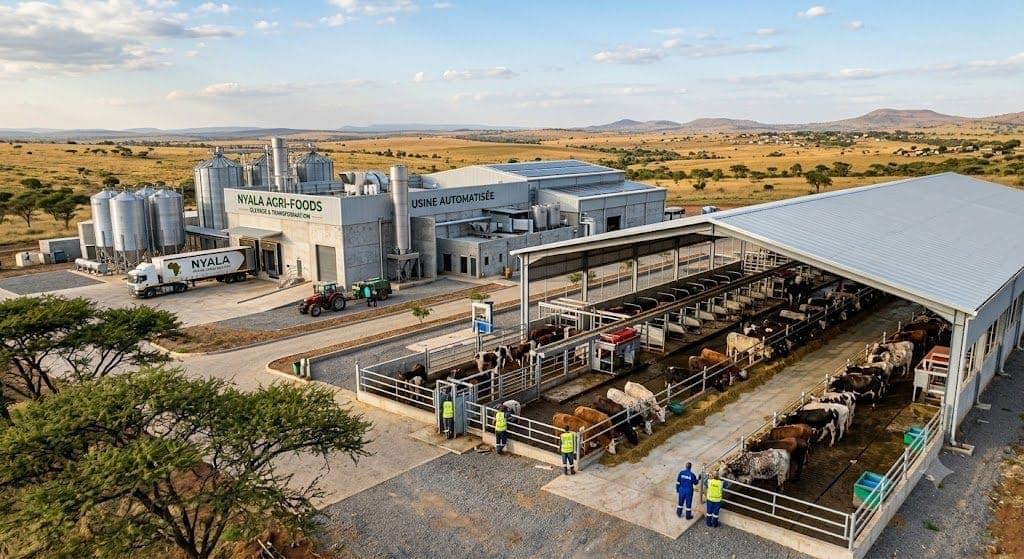
Meat and milk: cattle farming on the Adamawa and Northern plateaus is an economic and cultural pillar, with a major national dairy deficit to fill.
- Very low milk productivity of local breeds.
- Transhumance, land pressure and agro-pastoral conflicts.
- Scattered milk collection, cold chain almost absent.
- Dairy basins organized around mini-dairies.
- Crossbreeding and insemination for productivity.
- Cattle fattening and traceability for urban markets and regional export.
On the Adamawa and Northern plateaus, productivity is the first lever to activate.
- Genetic improvement through crossbreeding and artificial insemination.
- Feeding and pasture management for milk productivity.
- Cattle fattening for the meat value chain.
- Settlement and easing of agro-pastoral conflicts.
Milk is lost for want of organized collection and cold: this is the link to build.
- Organization of collection in the dairy basins.
- Collection centers and local cold chain.
- Loss reduction between barn and dairy.
Mini-dairies and cutting bring value addition closer to the farming areas.
- Mini-dairies: pasteurized milk, yoghurts, cheeses.
- Cattle slaughter and cutting to standard.
- Local brands and dairy products substituting for imports.
A major national dairy deficit and urban markets to win.
- Substitution for imported dairy products.
- Traceability for urban markets and regional export.
- Contracting with retail and processors.
Agrovita structures the cattle value chain, from herd to dairy.
- Farming, genetics and feeding engineering.
- Organization of dairy basins and the cold chain.
- Engineering of mini-dairies and market access.
From raw material to the circular economy (N1 → N4)
Note NS-20260829/DG/XPN-REF1: four processing levels, from raw packaged product (N1) to recovered by-products and waste (N4), with the destination industrial sector(s).
Dressed carcasses; chilled raw milk collected in tankers.
Vacuum-packed frozen cuts; bulk pasteurised milk; raw cream.
Aged cheeses; flavoured yoghurts; labelled packed meat; certified kilishi/dried beef.
Whey (animal feed, whey powder); bone and blood (feed meal); manure (biogas, fertiliser).
The product type describes what leaves the farm or the unit, in its state of sale — it is what triggers processing, cold-chain, compliance and certification services.
Market, post-harvest, logistics.
Cold chain, storage, corridor, product compliance.
Unit sizing, energy, food safety management.
Full unit, HACCP, labelling, brand.
44 referenced risks, rated and tied to a control plan. The dominant families for this value chain:
- Building a bankable file — The 7 items funders really expect — and the mistakes that get a file rejected out of hand.
- Quality certification checklist — GLOBALG.A.P., Organic, HACCP: where to start depending on your actor profile and your value chain.
- Structuring your financial plan — The CAPEX / OPEX / cash-flow-per-cycle method, applied to crop and livestock projects.
- Monter un dossier bancable — les 7 composantes essentielles — Ce qu'un comité de crédit attend réellement : les 7 composantes d'un dossier de financement solide.
- Fiche fiscale 2026 — Fiscalité foncière et sécurisation agricole au Cameroun — Ce que la Loi de Finances 2026 change pour vos terres : exonérations de TPF pour l'agriculture, l'élevage et la pêche, frais de bornage réduits de moitié, et l'immatriculation foncière en 4 étapes budgétées en FCFA.
- Guide 2026 des financements agricoles et agro-industriels au Cameroun — Les guichets qui financent réellement l'agriculture et l'élevage — BC-PME (FINAGRO, PIISAH), ACEFA, CamCCUL, MINADER, AFD (C2D), BAD — et la méthode pour leur présenter un dossier bancable.
- Auto-évaluation OHADA — votre GIC ou coopérative est-il éligible aux crédits ? — Grille de diagnostic en 4 domaines (structure juridique, comptabilité, gouvernance, sûretés) pour situer votre groupement face aux exigences de l'Acte Uniforme OHADA — la clé d'accès aux guichets de financement.
- The documents area — pieces to gather and templates.
Where projects in this value chain begin
A promoter seeking finance who wants the complete file in one engagement, rather than chaining pre-qualification, investment decision and financial structuring separately.
Indicative duration: About 16 weeks →Pre-qualify pathwayA promoter with an intention, a plot or an opportunity, but nothing formalised.
Indicative duration: 2 to 4 weeks →Decide to invest pathwayA promoter whose idea is mature and who is considering a significant financial commitment.
Indicative duration: 6 to 10 weeks →Design the facility pathwayA decided project whose means of production must be settled before costing.
Indicative duration: 8 to 14 weeks →Finance pathwayA designed project seeking financing matched to its cycle.
Indicative duration: 10 to 18 weeks →