
Agro-industries, slaughterhouses & industrial units
You operate industrial lines, slaughterhouses or cutting plants: you take processing to scale and towards export markets.
Definition in the architecture : Industrial processing, production lines, slaughtering and cutting
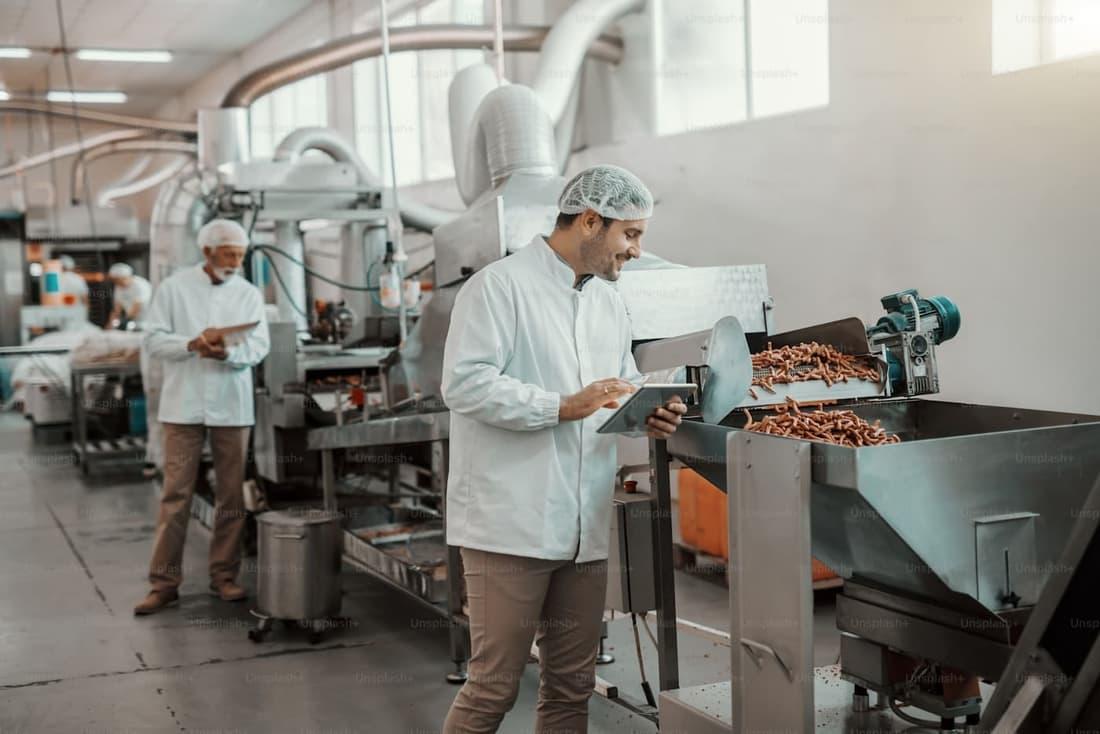
What you do
- Run industrial plant processing lines: oil mills, flour mills, sugar, brewing, cocoa
- Slaughter, cut, pack and chill meat and poultry in line with sanitary standards
- Organise raw material supply from producers, cooperatives and plantations
- Ensure quality control, traceability and production certifications
- Distribute finished products on the domestic market and for export
- Provide, as a secondary service, inputs and production contracts to partner producers
You are the industrial pivot of the Produce – Process – Export chain. You receive raw materials from commercial farms, cooperatives, livestock farmers and importers, together with equipment, energy and engineering services. You deliver finished products to distributors, wholesalers and export markets. As a secondary role, you supply inputs and contracts to partner producers and provide structured market access. You secure volume outlets for upstream actors and unlock access to regional and international markets.
Where are you found?Concentrated in industrial and port hubs: Douala and the Littoral, Yaoundé and the Centre, Kribi; plantation-based agro-industrial units in the Littoral, South-West and South; slaughterhouses and cutting plants in the main cities and in the livestock basins of Adamawa, the North and the West.
Why your business matters in Cameroon and Central Africa
Agro-industries and slaughterhouses form the backbone of processing in Cameroon. They provide large and regular outlets for crop and livestock value chains, create industrial jobs and spread quality standards upstream through contract farming. Their compliance with sanitary, HACCP and ISO standards and with customs requirements determines the access of Cameroonian products to CEMAC, Nigerian and wider markets. They reduce dependence on imported processed goods and strengthen the trade balance. Their development, backed by rigorous project engineering, sits at the centre of the agri-food industrialisation ambition of the country and the sub-region.
The headings that project promoters, partners and institutions look at first. Fill them in with your real orders of magnitude: this is what makes your profile usable.
- Make local raw material supply reliable through contract farming and aggregation
- Maintain the certifications and traceability required by export markets
- Cut energy and logistics costs and secure the cold chain from plant to point of sale
- Develop outlets across CEMAC, in Nigeria and under the AfCFTA framework
- Mobilise finance and engineering to modernise or expand capacity
What the directory brings to your organisation
Your industrial unit is identified by producers, cooperatives, equipment suppliers and distributors looking for a partner of scale.
You gain access to contract supply, technical partnership and investment opportunities put forward by ecosystem actors.
You position yourself within the agro-industrial network of Central Africa, oriented towards CEMAC, Nigerian and AfCFTA markets.
Your listing in three steps
The directory is not a mere listing: each profile is positioned within the architecture (sub-domain, actor, value chain), checked by XP-NOVA, then published. You keep control of your profile after publication.
- The form
You enter your organisation, your position in the architecture — pre-filled from this page —, your value chains, your area of operation and your contact details. Your profile is created as pending and you receive your access.
Start my registration - Verification by XP-NOVA
The XP-NOVA team reviews your profile: consistency of the position in the architecture, reality of the declared activity, completeness of the information. If there is a reservation, the reason is sent to you and you can complete.
- Validation and publication
Once validated, your profile is published in the directory available to members, under your actor code. You update it from your area: contact details, logo, capacities, description.
Browse the directory
Already registered? Go to my area · DP3 DP3.A32
Agro-industrial players operate large units: refining, brewing, milling, agro-parks.
- Securing local raw-material supply pools.
- Competitiveness against imports.
- Heavy investments to finance and secure.
- Structuring of contracted supply basins.
- Industrial feasibility studies and due diligence.
- Financial structures with escrow and verified milestones.
To industrial players: value chains ready for investment
Cameroon's agri-industry is establishing itself as a strategic investment theme — cocoa, palm oil, aquaculture, dairy. But premium opportunities demand more than production capacity: they demand structure, reliability, and a clear route to market.
XP-NOVA structures contracted supply basins, conducts industrial feasibility studies, and secures investments through rigorous fiduciary mechanisms — so that every industrial project rests on solid foundations.
- Organized, contracted supply basins.
- Industrial feasibility studies and due diligence.
- Secured financial structuring, disbursements on verified milestones.
The XP-NOVA team
The XP-NOVA offers that match you, step by step
Each offer carries its code and unfolds into the elementary services of the catalogue. The project only moves forward once the milestone is reached — start at the step you are at.
44 referenced risks, rated and tied to a control plan. These are the families of the register that touch your activity — rating your project is the object of the resilience assessment, the condition of the step 4 milestone of the cycle.
- Building a bankable file — The 7 items funders really expect — and the mistakes that get a file rejected out of hand.
- Quality certification checklist — GLOBALG.A.P., Organic, HACCP: where to start depending on your actor profile and your value chain.
- Structuring your financial plan — The CAPEX / OPEX / cash-flow-per-cycle method, applied to crop and livestock projects.
- Monter un dossier bancable — les 7 composantes essentielles — Ce qu'un comité de crédit attend réellement : les 7 composantes d'un dossier de financement solide.
- Guide 2026 des financements agricoles et agro-industriels au Cameroun — Les guichets qui financent réellement l'agriculture et l'élevage — BC-PME (FINAGRO, PIISAH), ACEFA, CamCCUL, MINADER, AFD (C2D), BAD — et la méthode pour leur présenter un dossier bancable.
- The documents area — the pieces to gather, step by step, and the templates.
Position within the architecture
Core — value creation
Other actors of the sub-domain — Processing