Livestock farmers
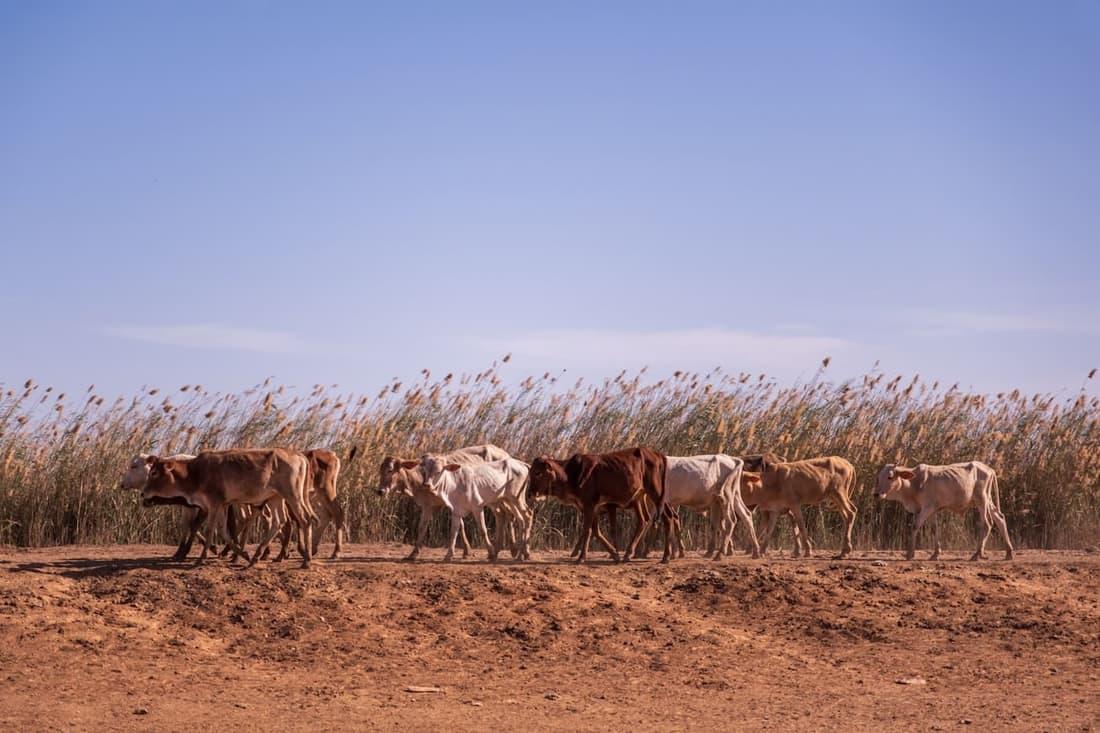
You raise cattle, sheep and goats, pigs or poultry, in traditional or intensive systems: you produce the country’s animal protein.
Definition in the architecture : Land-based livestock: cattle, sheep and goats, pigs, poultry, including fattening
What you do
- Manage cattle, sheep and goat herds on pasture or in fattening units
- Raise pigs and broiler or layer poultry in housed systems
- Provide feed, water and health monitoring for the animals
- Manage breeding and herd or flock replacement
- Sell live animals, eggs and milk on markets and to slaughterhouses
You are the first link in the livestock value chain. You receive animal feed, day-old chicks, breeding stock, veterinary products and advice from suppliers and livestock services. You deliver live animals, eggs and milk to cattle markets, butchers, slaughterhouses, cooperatives and processing units. You secure the supply of meat, eggs and dairy products to the cities, and you unlock the activity of slaughterhouses and processors by providing animals in sufficient numbers and in compliant health condition.
Where are you found?Cattle, sheep and goat farming in Adamawa, the North, the Far North and on the Western and North-West highlands; poultry and pig farming concentrated in the West, Centre and Littoral, around Yaoundé, Douala and Bafoussam; small family herds and flocks found across the whole country.
Why your business matters in Cameroon and Central Africa
Livestock holds a central place in Cameroon’s rural economy, particularly in the northern regions and on the highlands. It supplies animal protein to households, serves as living savings for families and feeds active regional markets towards CEMAC and neighbouring Nigeria. Peri-urban poultry and pig farming answer the growing demand of the cities. Animal health control, genetic improvement and access to quality feed are the levers of the country’s protein sovereignty. The organisation of livestock farmers also determines the regular supply of slaughterhouses and processing industries.
The headings that project promoters, partners and institutions look at first. Fill them in with your real orders of magnitude: this is what makes your profile usable.
- Access quality feed, day-old chicks and breeding stock at controlled prices
- Strengthen animal health coverage and the prevention of epizootic diseases
- Secure outlets with slaughterhouses, processors and cooperatives
- Reduce losses linked to animal transport and to gaps in the cold chain
- Access finance suited to the livestock cycle and to investment in buildings
What the directory brings to your organisation
Your farm is visible to slaughterhouses, processors, feed suppliers and veterinary services looking for identified livestock producers.
You gain access to pooled purchasing offers, delivery contracts and technical support put forward by livestock value chain actors.
You take your place in the livestock network of Central Africa, connected to cattle markets and to CEMAC trade circuits.
Your listing in three steps
The directory is not a mere listing: each profile is positioned within the architecture (sub-domain, actor, value chain), checked by XP-NOVA, then published. You keep control of your profile after publication.
- The form
You enter your organisation, your position in the architecture — pre-filled from this page —, your value chains, your area of operation and your contact details. Your profile is created as pending and you receive your access.
Start my registration - Verification by XP-NOVA
The XP-NOVA team reviews your profile: consistency of the position in the architecture, reality of the declared activity, completeness of the information. If there is a reservation, the reason is sent to you and you can complete.
- Validation and publication
Once validated, your profile is published in the directory available to members, under your actor code. You update it from your area: contact details, logo, capacities, description.
Browse the directory
Already registered? Go to my area · DP2 DP2.A21
They raise poultry, pigs and ruminants for meat, milk and eggs, at the heart of the livestock domain.
- Cost and quality of animal feed.
- Animal health and farm biosecurity.
- Marketing dominated by informal intermediaries.
- Design of buildings and modern technical management.
- Prophylaxis and biosecurity plans.
- Contracting with slaughterhouses, dairies and distributors.
To livestock farmers: growing together in animal farming
In the beginning, there is often the same story. A livestock farmer rises early, works with courage, feeds the animals, watches over them, faces disease, costs, and difficult seasons… and despite all that effort, sometimes wonders how to turn this work into stable income, a durable activity, a real opportunity for the family.
Then another path appears: the livestock farmer is no longer alone. Producers organize, ideas circulate, efforts are pooled. It is no longer only about producing, but about producing better, selling better, adding more value. It is within this dynamic that XP-NOVA steps in.
Because livestock farming should not be merely a means of survival. It can become a source of stable income. It can create jobs. It can feed families. It can help territories grow.
- Organize production and strengthen your capacities.
- Improve quality and command health and sanitary risks.
- Build projects that find their place in real markets.
- Build solid relationships with buyers and funders.
The XP-NOVA team
The XP-NOVA offers that match you, step by step
Each offer carries its code and unfolds into the elementary services of the catalogue. The project only moves forward once the milestone is reached — start at the step you are at.
44 referenced risks, rated and tied to a control plan. These are the families of the register that touch your activity — rating your project is the object of the resilience assessment, the condition of the step 4 milestone of the cycle.
- Building a bankable file — The 7 items funders really expect — and the mistakes that get a file rejected out of hand.
- EUDR compliance for producers — The European deforestation regulation: what changes for Cameroonian cocoa, coffee and rubber.
- Quality certification checklist — GLOBALG.A.P., Organic, HACCP: where to start depending on your actor profile and your value chain.
- Structuring your financial plan — The CAPEX / OPEX / cash-flow-per-cycle method, applied to crop and livestock projects.
- Monter un dossier bancable — les 7 composantes essentielles — Ce qu'un comité de crédit attend réellement : les 7 composantes d'un dossier de financement solide.
- Guide de conformité aux exigences d'exportation — Règlement Déforestation (RDUE) Cacao & Café — Exporter vers l'UE après le RDUE : géolocalisation des parcelles, diligence raisonnée et preuves attendues.
- Fiche fiscale 2026 — Fiscalité foncière et sécurisation agricole au Cameroun — Ce que la Loi de Finances 2026 change pour vos terres : exonérations de TPF pour l'agriculture, l'élevage et la pêche, frais de bornage réduits de moitié, et l'immatriculation foncière en 4 étapes budgétées en FCFA.
- Guide 2026 des financements agricoles et agro-industriels au Cameroun — Les guichets qui financent réellement l'agriculture et l'élevage — BC-PME (FINAGRO, PIISAH), ACEFA, CamCCUL, MINADER, AFD (C2D), BAD — et la méthode pour leur présenter un dossier bancable.
- Auto-évaluation OHADA — votre GIC ou coopérative est-il éligible aux crédits ? — Grille de diagnostic en 4 domaines (structure juridique, comptabilité, gouvernance, sûretés) pour situer votre groupement face aux exigences de l'Acte Uniforme OHADA — la clé d'accès aux guichets de financement.
- The documents area — the pieces to gather, step by step, and the templates.
Position within the architecture
Upstream — livestock production (land-based)
Other actors of the sub-domain — Livestock