
Smallholder & family farms
You grow food and cash crops on your own or with your family: you are the foundation of Cameroon’s agricultural production.
Definition in the architecture : Individual or family crop production, food and cash crops alike
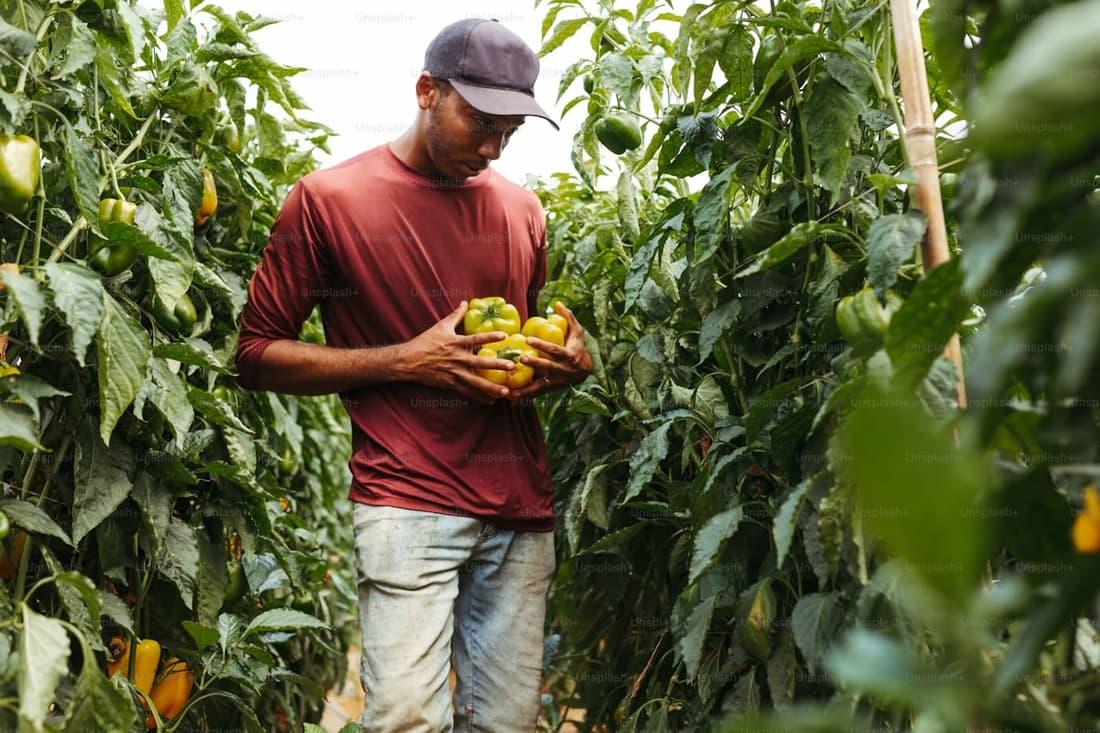
What you do
- Grow staple food crops: cassava, maize, plantain, cocoyam, groundnut, yam and vegetables
- Manage cash crops such as cocoa, coffee, oil palm, rubber or cotton depending on the area
- Prepare land, sow, maintain and harvest with family labour
- Dry, sort and store part of the harvest for home consumption and sale
- Sell surpluses on local markets, to collectors or through the cooperative
You are the first link in the Produce – Process – Export chain. You receive seeds, seedlings, fertiliser and advice from nurseries, input dealers and support services. You deliver your harvests to local markets, collectors, cooperatives and processing units. Your output feeds households, cities and export value chains. Without steady, well-supported family farms, neither processors nor exporters can count on a sufficient and traceable supply of raw material.
Where are you found?Across the whole country, with profiles that vary by production basin: food crops and cocoa in the Centre, South and East; coffee, market gardening and high-density cropping on the Western Highlands and in the North-West; oil palm, cocoa and plantain in the Littoral and South-West; cotton, sorghum, millet and groundnut in the Sudano-Sahelian zone of the North and Far North.
Why your business matters in Cameroon and Central Africa
Family farms provide most of the food consumed in Cameroon and a large share of the cash crops sent to export markets. They sustain rural areas, keep young people in their villages and preserve local farming know-how. Their organisation into cooperatives is what makes value chains work and opens access to regional markets in CEMAC and neighbouring Nigeria. Traceability requirements, notably the EUDR for cocoa, coffee and palm oil, now place the smallholder at the centre of export compliance. Strengthening productivity, climate resilience and access to finance on these farms is a condition for national food sovereignty.
The headings that project promoters, partners and institutions look at first. Fill them in with your real orders of magnitude: this is what makes your profile usable.
- Gain access to certified seed, quality inputs and nearby technical advice
- Cut post-harvest losses through shared storage and direct links with processors
- Secure stable outlets and negotiated prices through cooperatives and listed buyers
- Meet the traceability and sustainability requirements of export markets
- Access seasonal finance and crop insurance suited to small plots
What the directory brings to your organisation
Your farm becomes visible to cooperatives, collectors, processors and input suppliers looking for identified producers.
You receive offers for production contracts, joint marketing and technical support put forward by value chain actors.
You take your place in the agro-pastoral ecosystem of Cameroon and Central Africa, connected to value chains serving CEMAC markets.
Your listing in three steps
The directory is not a mere listing: each profile is positioned within the architecture (sub-domain, actor, value chain), checked by XP-NOVA, then published. You keep control of your profile after publication.
- The form
You enter your organisation, your position in the architecture — pre-filled from this page —, your value chains, your area of operation and your contact details. Your profile is created as pending and you receive your access.
Start my registration - Verification by XP-NOVA
The XP-NOVA team reviews your profile: consistency of the position in the architecture, reality of the declared activity, completeness of the information. If there is a reservation, the reason is sent to you and you can complete.
- Validation and publication
Once validated, your profile is published in the directory available to members, under your actor code. You update it from your area: contact details, logo, capacities, description.
Browse the directory
Already registered? Go to my area · DP1 DP1.A01
They work the land — food crops, cash crops, market gardening, fruit — and form the base of all crop value chains.
- Access to quality inputs and campaign financing.
- Climate and phytosanitary vulnerability of crops.
- Low farm-gate prices due to a lack of organization and storage.
- Technical itineraries and sustainable intensification.
- Structuring into cooperatives to weigh on prices.
- Campaign and equipment financing files.
To farmers: writing a different trajectory
In rural areas, agricultural projects are born full of hope. The people are committed, the resources mobilized… but soon the same obstacles appear: lack of structure, difficulties accessing the market, uncertain financing. And too often, the potential goes untapped.
At XP-NOVA, everything starts with one essential question: “What is the demand?” From there, we design projects with you following a precise logic: produce what the market expects, transform to create more value, and reach durable market outlets — including for export.
- Rigorous structuring of your farm and your projects.
- Command of the risks tied to rural activities.
- Support toward technical and quality standards.
- Projects that are more credible, easier to finance, and more profitable.
The XP-NOVA team
The XP-NOVA offers that match you, step by step
Each offer carries its code and unfolds into the elementary services of the catalogue. The project only moves forward once the milestone is reached — start at the step you are at.
44 referenced risks, rated and tied to a control plan. These are the families of the register that touch your activity — rating your project is the object of the resilience assessment, the condition of the step 4 milestone of the cycle.
- Building a bankable file — The 7 items funders really expect — and the mistakes that get a file rejected out of hand.
- EUDR compliance for producers — The European deforestation regulation: what changes for Cameroonian cocoa, coffee and rubber.
- Quality certification checklist — GLOBALG.A.P., Organic, HACCP: where to start depending on your actor profile and your value chain.
- Structuring your financial plan — The CAPEX / OPEX / cash-flow-per-cycle method, applied to crop and livestock projects.
- Monter un dossier bancable — les 7 composantes essentielles — Ce qu'un comité de crédit attend réellement : les 7 composantes d'un dossier de financement solide.
- Guide de conformité aux exigences d'exportation — Règlement Déforestation (RDUE) Cacao & Café — Exporter vers l'UE après le RDUE : géolocalisation des parcelles, diligence raisonnée et preuves attendues.
- Fiche fiscale 2026 — Fiscalité foncière et sécurisation agricole au Cameroun — Ce que la Loi de Finances 2026 change pour vos terres : exonérations de TPF pour l'agriculture, l'élevage et la pêche, frais de bornage réduits de moitié, et l'immatriculation foncière en 4 étapes budgétées en FCFA.
- Guide 2026 des financements agricoles et agro-industriels au Cameroun — Les guichets qui financent réellement l'agriculture et l'élevage — BC-PME (FINAGRO, PIISAH), ACEFA, CamCCUL, MINADER, AFD (C2D), BAD — et la méthode pour leur présenter un dossier bancable.
- Auto-évaluation OHADA — votre GIC ou coopérative est-il éligible aux crédits ? — Grille de diagnostic en 4 domaines (structure juridique, comptabilité, gouvernance, sûretés) pour situer votre groupement face aux exigences de l'Acte Uniforme OHADA — la clé d'accès aux guichets de financement.
- The documents area — the pieces to gather, step by step, and the templates.
Position within the architecture
Upstream — crop production
Other actors of the sub-domain — Agriculture