
Agriculture
The Agriculture domain (DA) covers the plant value chains — cash crops, staple foods, market gardening, fruits, oilseeds, medicinal and aromatic plants — and the ecosystem that keeps them alive: input and seedling supply, production, cooperatives, intermediaries, primary processing, distribution, specialised services and the sector's institutions.
structured crop value chains (FV01–FV07)
of the working population lives off agriculture
Cameroon's leading export sector outside hydrocarbons
- Farm productivity still falls well below agronomic potential.
- High post-harvest losses due to a lack of storage, packaging and logistics.
- Difficult access to finance: few bankable files, weak land collateral.
- New export-market requirements: traceability, certification, EUDR compliance.
- Structuring of bankable agricultural projects, from feasibility study to financing.
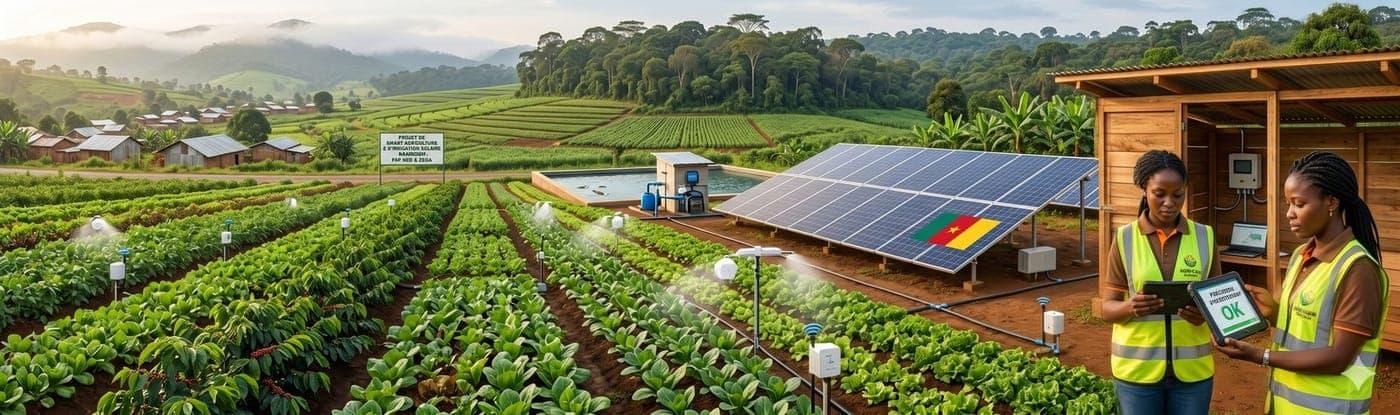
- Technical engineering: land servicing, irrigation, precision agriculture.
- Quality and traceability compliance for premium markets and export.
- Matchmaking across value-chain actors through codified mapping.
8 families, each with its actors
Suppliers of inputs, seeds, seedlings and equipment that prepare the season: other people's projects start with them.
The farms that produce plant raw material, from the family plot to the irrigated scheme.
Cooperatives and producer organisations that pool resources, volumes and market outlets.
First-level collectors and traders who aggregate production and connect it to markets.
The harvest's first passage through the workshop: drying, milling, crushing, hulling.
Wholesalers and retailers who move plant products through to the consumer.
Agricultural advisory, analyses, machinery services: services specific to plant value chains.
The institutions dedicated to the agricultural sector: framing, support, regulation.
9 value chains
Cocoa, coffee, cotton and rubber: structuring, quality and access to premium markets. Basins: cocoa — Centre, South-West, Littoral, South, East; robusta coffee — Centre, South, Littoral; arabica — West, North-West; cotton — Far North and North; rubber — South-West and Littoral.
Explore →Maize, cassava, plantain and yam: food security and productivity. Basins: maize and sorghum — Far North, North, Adamawa; cassava and taro — Centre, South, East, Littoral; yam — North and Adamawa.
Explore →Vegetables: intensive production, cold chain and supply to urban markets. Basins: West (Foumbot, Dschang) and the outskirts of Yaoundé and Douala.
Explore →Pineapple, banana, mango and citrus: quality, packing and export. Basins: banana, plantain and pineapple — Littoral (Moungo, Njombé-Penja) and South-West; mango — Far North and North.
Explore →Oil palm, groundnut, soya and sesame: production and crushing. Basins: oil palm — South-West (Ndian, Meme), Littoral (Edéa), South (Kribi); groundnut — Far North, North, Adamawa.
Explore →Valorisation, traceability and processing into high-value products. Estimated basins: East, South and Centre, in the forest zone.
Explore →Drying, packing and access to specialty markets. Basins: Penja pepper — Littoral (Moungo); other spices — South, East and Centre forest zone.
Explore →Seed production and certification; cuts across every crop chain. Estimated basins, low confidence: agricultural research centres in the Centre and North-West.
Explore →Cut flowers, ornamental plants and nurseries. Estimated basins: outskirts of Yaoundé, highlands of the West and North-West.
Explore →